From Hugh Grosvenor
Day 2 of the 2025 Victorian Festival of Bridge was the second half of the Swiss Pairs events for Open, Mixed and Restricted Categories.
George and I started against Matti Shub and John Quayle from the South Gippsland Bridge Club. Focus and concentration are vital to success in bridge. Matti was clearly distracted by various things going on around us – director calls at other tables, people moving around, the sound of chairs moving, the temperature of the room, problems with the Bridgemates etc. Most of these environmental variables are beyond your control so it is important to ignore them, however hard that may be. If you can’t do this, it is very hard to play good bridge.
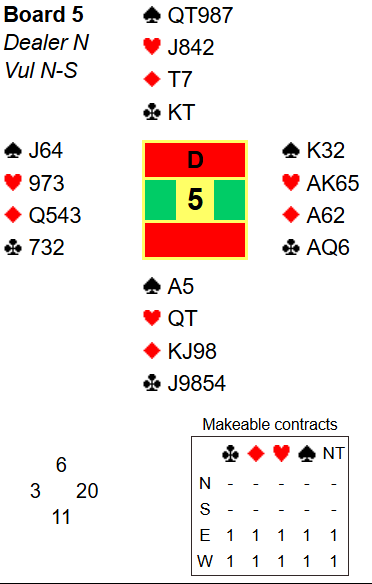
I opened 2NT, 20-22 balanced, everyone passed. Matti led a low club to partner’s K which held the first trick. Usually, it is best to wait to take your stoppers unless there is an urgent need to win the trick. Here I have only 5 immediate tricks (2 clubs, 2 hearts and the DA). There is potential to make extra tricks in each of the other suits, but it will require a bit of luck. John continued a club which I won. A low D to the Q worked so now I was up to 6 tricks. I could lead a S to the K now but if that lost to the Ace I would be in real trouble. I would rather the opponents led spades. I played a heart from the dummy and played low. Now I might have 3 heart tricks if they divided 3-3. Matti continued with a club on which John pitched a diamond. I now cashed the two top hearts. On the king of hearts Matti discarded the SA! I cashed the DA and when John showed out I could cash the SK and exit with the last heart. John had only spades and had to give me the SJ for an unlikely 8 tricks.
This hand set the tone for the match and we gained small IMPs on almost all the hands. Our biggest IMP gain was 8 IMPs on Board 14 but it totalled a 43 IMP win for 20-0 on VPs.
Board 2 came near the end of the match for us.
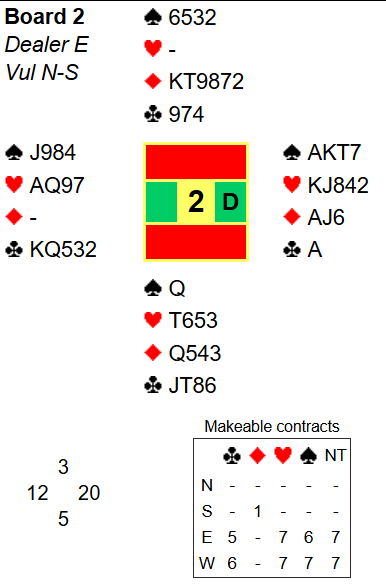
What would you open with the East hand? I chose 2NT (20-22 balanced). Not perfect but I don’t like the idea of opening 2C on this type of hand. For me it was a choice between 2NT and 1H. George bid 3C, Puppet Stayman, asking me about 4 or 5 card major holdings. John produced a courageous 3D call. Since they were vulnerable and we were not there was some temptation to double but equally it seemed strange not to show my 5 card major when we were guaranteed a fit in one or the other major. I bid 3H and was slightly surprised when Matti bid 4D. George settled for 6H I suspect slightly influenced by his impression of the state of the match. He thought we were well ahead and didn’t want to have an accident on this hand. 7H was easy even with the 4-0 trump break. Despite the fact that we had 13 easy tricks just bidding 6 was worth one IMP to us. Bidding grand slams that you are not sure about is a mug’s game!
Match 6 was against the top seeds in the event. Joe Haffer and Phil Markey are on the current Australian Open team. The team just won bronze in Hefei. They are one of the most consistently successful pairs in the country and play a super aggressive natural style that they call Outback Acol. They know no fear and play an exciting form of the game. Check out a couple of the boards from this match!
This was the first board.
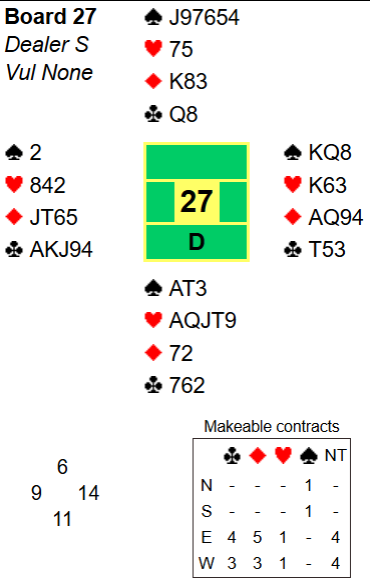
George opened 1H, Phil overcalled 2C which was alerted and explained as showing 5+ clubs limited to 14 HCP but not promising any values. I tried X, intending to rebid 2S to show a hand not strong enough to bid 2S forcing. Joe speculated with 3NT which became the contract. George led HA followed by HQ. Joe won this, crossed to the CA and ran the DJ. He repeated this finesse and cashed 4 diamonds. Now he had to negotiate the club suit. It seemed that George had started with AQJ of hearts and the SA (his heart play suggested that he had an entry i.e. the SA). This only left me with the DK and the SJ. This was not really enough for my X so Joe played a club to the ace dropping my Q and making 10 tricks. Nice card reading from him but not a great start for us.
Second hand you are vulnerable, and they are not. Phil passes and you hold Kxx AJ9x – KQJTxx. You open 1C, Joe overcalls 3NT and that is passed back to you. Presumably he has the CA and a bunch of diamond tricks. What are you going to do? I chose 4C this was passed to Phil who doubled. Joe passed and I awaited the dummy with some trepidation.
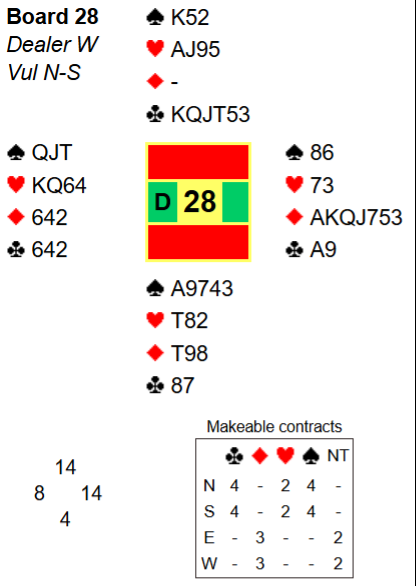
Not a bad dummy under the circumstances. I ruffed the D lead and played a C. Joe won A and played another D. I erred here and did not ruff but rather chose to pitch a H with the idea that
this would break the defensive communication in case the trumps did not break. Joe could now have beaten me by switching to a Heart. He continued diamonds and when both black suits broke I scored up +710. 22 IMPs traded and we’ve only played two boards!
The fourth board is this one.
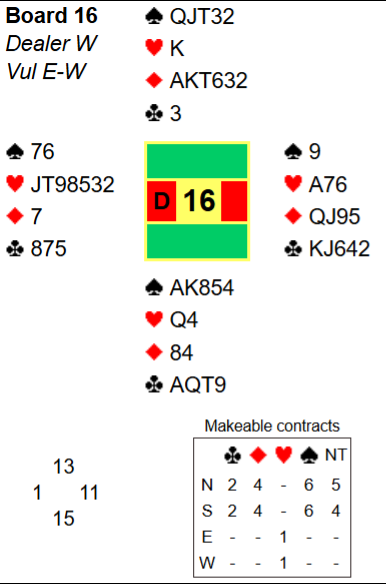
Phil opened a speculative 3H. Super aggressive at the vulnerability but that is their thing. I like to play that 4m now shows a two suited hand with that suit and the other major (non-leaping Michaels) but George and I don’t play this, so I settle for 3S. Obviously Joe has seen Phil’s pre- empts before so he passes despite having a singleton and Axx support. Not sure that I agree with this. George bid 4H to show a good S raise. I like some parts of my hand, but the HK is of questionable value. 65 shapes are good. After some thought I bid 4S. George can’t really bid any more particularly after my break in tempo. 12 tricks are simple, so this feels like a loss. As it turns out only 5 IMPs but it doesn’t feel good.
Now you hold AKQxxx xxx A QJx. You are Vulnerable and they are not. George opens 1D and Phil overcalls 1S. Over to you. The vulnerability is not in favour of trying to penalise them but it seems strange not to. I passed (expecting partner to reopen with a double). Joe bids 3S! Now it is clear that something strange is happening. This is passed back to you. Double here is penalties so that is your choice. This is passed back to Phil who bids 4H. Now what? Phil does not have spades but they are very high so I doubled again. Joe bid 4S and George doubled. This was passed out. Since I was trying to defend 1SX, 4SX was beyond my expectations.
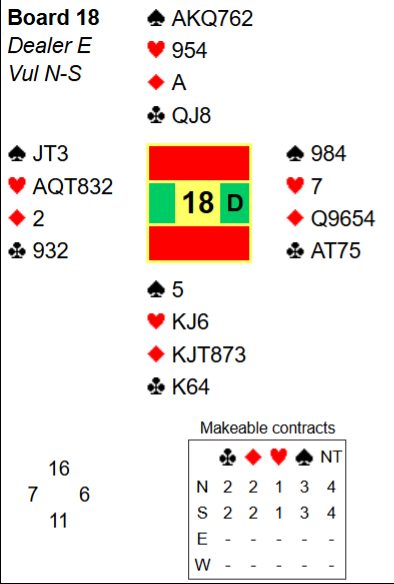
I drew three rounds of trumps and switched to a C. Phil managed 3 tricks for down 7 and -1700. Not a word was exchanged. Joe’s decision to bid 4S was pretty strange in my opinion.
I often tell my students that they should not be so worried about bad scores, all the worst scores that I have ever seen have been from expert pairs. Living on the edge means that occasionally you slip into the abyss!
In a career of over 40 years the worst score that I have ever seen was achieved by me. We played 4CXX resulting in a score that was a Queensland postcode (my brain has chosen to redact the exact information but suffice it to say that it was more than 4000). You may think that this was probably some club game that we were not taking too seriously. Well actually it was in a national championship, the Butler trials in Perth sometime in the 1980s.
Board 20 was a little harsh but reflects what happens when you are in your opponent’s faces all the time.
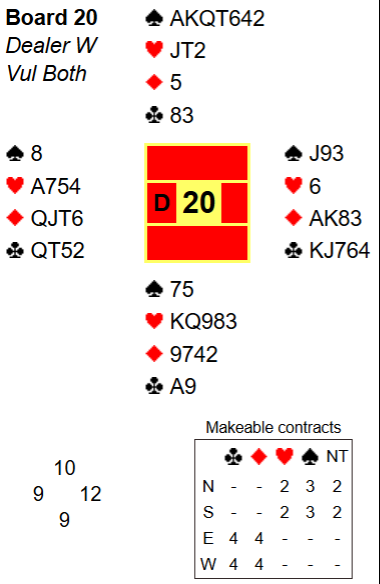
Phil opened 1D. If he had passed, I would probably have opened 4S. Over an opening bid the value of pre-empting changes a little. I bid 3S and Joe bid 4D which was passed out
EW can beat 4S but it is pretty double-dummy (H lead to A, H back ruffed, small D away from AK to partner’s Q for another H ruff). Only one pair in the field managed to hold NS to 9 tricks.
EW can make 10 tricks in either minor but could easily make 11 if the defence slips. -10 IMPs for 4D making 10 was disappointing.
After an exciting match we lost by 4 IMPs, not great.
Match 7 was against another member of the Australian Open team, David Wiltshire. David is a great player and one of the nice guys of the bridge world. He is playing this event with Alex Goss, a young player with great potential (also seems like one of the nice guys).
This was a fairly flat match. One of the things that you see in IMP scored events with large fields is that it pays to hold the cards. If you bid a cold game it is likely that you will gain a few IMPs. In this match they bid 3 games that we could do little about, 2 with overtricks, one that was a thin slam in another suit. This was a gain of 8 IMPs for them.
There was one hand where we controlled our own fate.
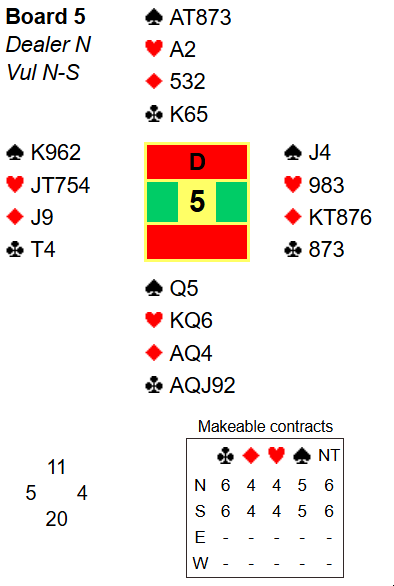
I opened 1S. George bid 2C which showed one of 3 hands, either an invitational or better 3- card raise, a balanced game force or a game force with clubs. I bid 2S saying that I would not accept a 3-card limit raise. George bid 2NT showing a balanced GF. I bid an easy 3NT. George was still interested in slam – what should he bid? I think 4C would be best. This would show 5 clubs and slam interest. I would have bid 4H showing 3 keycards in a hand that was prepared to cooperate in bidding slam in clubs.
George chose to bid 5NT which was forcing and offered a choice of contract. Clearly I should have bid 6C but chose to bid 6NT. The play was interesting. George won the H lead and played a S to the Q and K. Alex returned a D. Now as he cashed his tricks George discovered that Alex had 4 spades. Eventually he finessed the ST to go 2 down. He could have made by guessing the spade position, but I think his line of play was fine.
Both of us could have bid better to arrive in 6C. This would have been an easy make, probably not needing the diamond finesse. 2 down was a 13 IMP loss, making 6C would have been a 12 IMP gain. Pretty cruel in a match that we lost by 6 IMPs.
The last match saw us playing Ian Robinson and Neil Ewart. Ian and I played together for some time in a previous life. He is a talented player who taught me a lot about playing tough, trying to win every trick both in defence and as declarer. Never settle for one down if you can
beat them two. Work hard at making overtricks. Neil is an old friend who plays with enthusiasm, humour and not a little skill. Strangely his background is in accounting!
One thing that I have learned in a long life in bridge is that blaming your partner for things that go wrong is generally unproductive. It doesn’t make them play better or feel better about themselves. Your partner is the only person at the table who is on your side. If something goes wrong it is much more useful to say nothing or apologise even if it is not your fault.
George was the declarer in 6H on this hand.
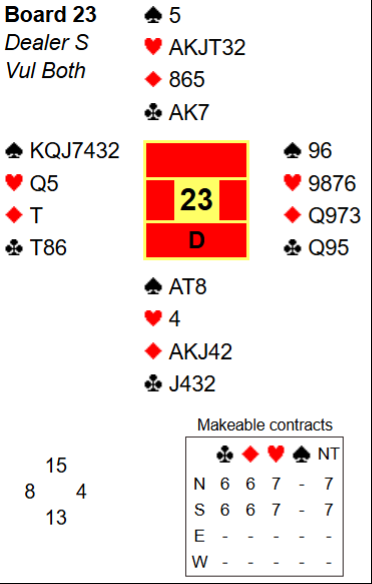
The bidding had gone 1D from me, 3S from Neil, 6H from George. George won the 9S lead in the dummy, finessed the HJ and drew trumps. He had a fairly easy 12 tricks and could have made 13 given that Ian was squeezed in the minor suits. He played a little carelessly then maybe didn’t give the end position enough thought and managed to go one down. I had no reason to say anything but it was a bad result.
Have you worked out why this was my fault? I hadn’t until I was looking for this hand tonight. I always sit North and on this hand I was South. Admittedly George put the board on the table the wrong way round, but I could have picked this up. I may well not have shown his flair in the bidding but I would probably have made my contract.
Two boards later this hand came along.
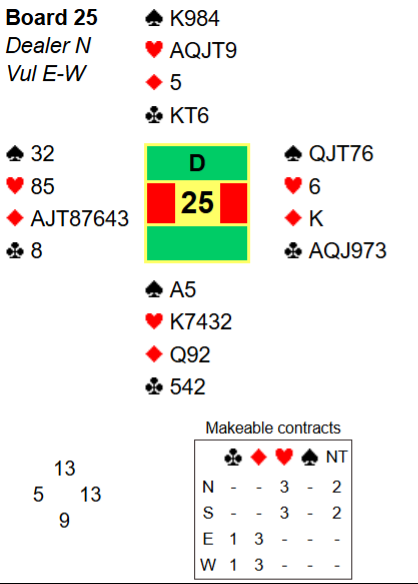
I opened 1H, Neil overcalled 2C, George bid 4H, this was passed back to Neil who tried 4S. Ian had a tricky decision. He chose 5C on his singleton and this was passed back to George. He bid 5H which was doubled. I managed to get out for one down but that was still 10 IMPs out.
Assign the blame. They could not make anything. Bidding 5 over 5 is generally considered to be a cardinal sin. I’m not keen on George’s choice but empathise with his idea that they probably had a good fit since we had a good fit. Should I have doubled with the two black kings sitting under Neil?
We lost by 11 IMPs to finish 29th out of 124. A disappointing conclusion but there is always tomorrow!
The winners of the Open were Liam Milne and James Coutts, members of the current Australian Open team.
The Mixed was won by Dagmar Neumann and Maurits Van der Vlugt. Dagmar is on the Australian Womens Team and Maurits is on the Seniors team.
The Restricted winners were Glen Chick and Steven Kemp.
The Tasmanian contingent:
Open (124 pairs):
- George and I finished 29th
- Marg Enright and Sue Falkingham finished 95th
- Jeremy Reid and Seb Wright finished 106th
- Margaret Robertson and Quentin Van Abbe finished 110th
Mixed (28 pairs):
- Sandra and Andrew Richman finished 10th
Restricted (26 pairs):
- Gek Low and Christine Chodasewicz finished 26th
The main event, the Victor Champion Cup, starts tomorrow.
All the scores are here.