From Hugh Grosvenor
The Victorian Festival of Bridge started today in Melbourne and will continue until Monday. This event is a rebranding of the Victor Champion Cup tournament which has a long history as Victoria’s annual national event.
We are at a new venue, the Amora Hotel Riverwalk in Richmond, with a new tournament organiser, Laura Ginnan. Laura was our captain in Hefei China, so I have first-hand experience of her energy and enthusiasm. So far her choice of venue seems good particularly since there are many choices for accommodation and after game drinking and dining. The playing conditions are a little cramped but that’s only because the event is so popular. The hotel staff seem to be coping with the demanding bridge crowd.
Tasmania has a fair representation. I am playing with George Kozakos my partner in the Australian Seniors Team – this is the only tournament that we have before the World Championships in Denmark, so it is a valuable chance for practice. Sandra and Andrew Richman are preparing for another ANC representing Tasmania in the Open Team. Jeremy Reid is playing with Seb Wright, Jeremy and Seb won the Restricted Pairs at TFOB two years ago. Sue Falkingham and Marg Enright came over last Friday and played the Moonee Valley Congress as a warmup and now are playing the VFOB – who said these girls are not keen! Margaret Robertson from Launceston is playing with Victorian Quentin Van Abbe. Gek Low is playing with Christine Chodasewicz, a Stepbridge partnership I believe. Of course, Simon Edler is an important part of the Tournament Director staff. Apologies if I have missed anyone.
The first two days are IMP scored Swiss Pairs events divided into Open, Mixed and Restricted fields. Sandra and Andrew are playing in the Mixed, Gek is playing the Restricted and the rest of us are in the Open.
Swiss Pairs events are a lot of fun but incorporate a fair bit of luck, particularly in a large field. Who you draw for each round is the main determinant of your fate. Often a small difference in score will mean that you play either a very strong pair or one who is not so well credentialed. The Open field has 124 Pairs with a random draw for the first round. We are seeded 5 and draw the pair seeded 12. Not a great draw for either pair! Justin Mill is a good friend and one of the best players around – he is playing with Arlene Dalley, a friend and sometime teammate from Sydney whose team beat my team in the final of the recent Adelaide Autumn Nationals and is on the current Australian Mixed Team.
It’s the first board, morning, maybe not enough caffeine. Everyone vulnerable you are East.
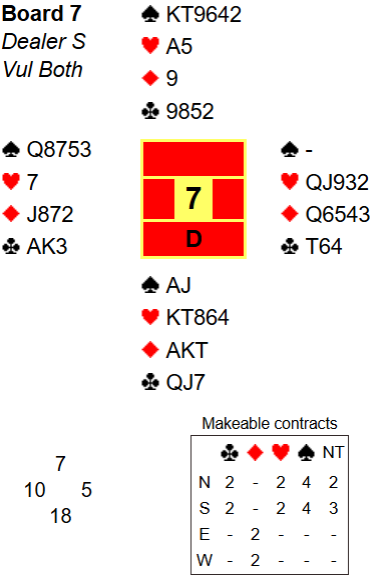
Arlene on your left opens 1H, George bids 1S and Justin passes. This doesn’t look good but anything you do now is likely to dig a deeper hole, so you pass. Arlene doubles and that is passed back to you. What do you bid? When experienced opponents penalise you at the one level it is generally not best for you, so I am not going to pass. Now I seem to have three options: XX, 1NT or 2D. 2D seemed too committal, either XX or 1NT might be right but I decided on XX. Arlene passed and George bid 2D. There is light at the other end of the tunnel! Justin doubled for take out, I obviously passed with relief and that was passed out. The contract was 2DX.
Justin led AH and continued a heart. How would you play?
I often hear people say ‘You could make X tricks’ after looking at the hand record, or more specifically the double-dummy results on the hand record. Here it says that you can make 2D. My question is how?
George played a big H, covered and ruffed. He ruffed a S in the dummy crossed to CA and ruffed another S. JH pitching a club while Justin ruffed. Now when Arlene could over-ruff the third S, she could cash two trumps for 2 down doubled. The defence had scored all four of their trumps! Fortunately George pointed this out so I didn’t have to worry about biting my tongue!
It was a tough hand. George could have done better by playing a trump after ruffing a S. This might even have resulted in the contract making when Arlene was endplayed. Still not obvious. -500 didn’t feel like a good start to the event! Notice that the only making game contract was 4S by them so running from 1SX was a good decision.
Board 10 was another interesting board.
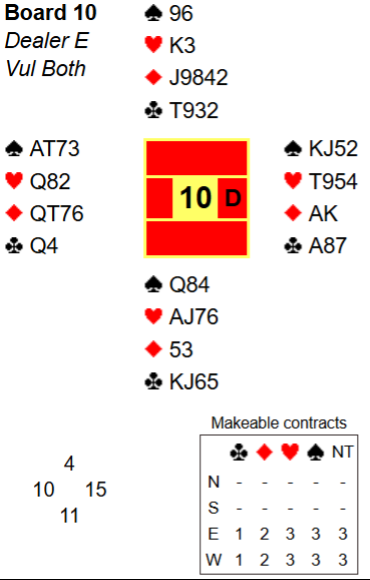
I opened 1NT as East and George chose to bid 3NT. With a 4432 shape I would have chosen to bid 2C Stayman with his hand. This would have resulted in us playing in 4S. They could beat this by getting a H ruff, scoring two hearts a ruff and then waiting for the CK. In reality this wouldn’t happen. In 3NT on a H lead and continuation I had to guess who had the SQ. I didn’t have much to go on and played for the hand which only had 3 hearts to have the SQ. When this didn’t work and the DJ didn’t fall I went one down. The only consolation was that in 4S if they didn’t get the H ruff I might also have to guess the SQ.
The rest of the hands went slightly in our favour (we lost 17 IMPs on those two boards) so the result of the match was 0 IMPs for 10 VPs each.
There were 8 pairs who scored a draw in the first round. Obviously, we had played one of them already. The other pairs were seeded 4, 26, 45, 58, 85 and 117. I’m not sure how the algorithm chooses between equal scoring pairs, but I invite you to guess who our opponents were for the second round. Yes, we played Pauline Gumby and Warren Lazer, the two highest ranked players on the ABF Masterpoint scheme.
We were lucky on the first board when Pauline and Warren had an unusual bidding misunderstanding and played in 5D rather than 3NT.
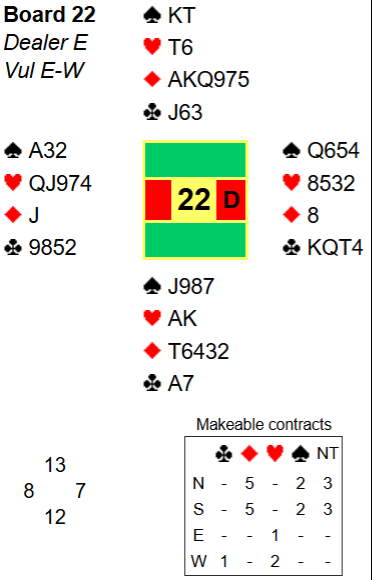
In 5D Warren misguessed the spades and went one down to lose 10 IMPs. It’s almost always better to play 3NT rather than 5 of a minor even if you have a great fit.
The rest of the match was not so good for us. They played and defended well to beat us by 13 IMPs.
The third match saw us drawn against a pair from country Victoria that I had heard of but didn’t know. It was a pleasant match characterised by the opponents probably not bidding enough.
This was our biggest gain for the match:
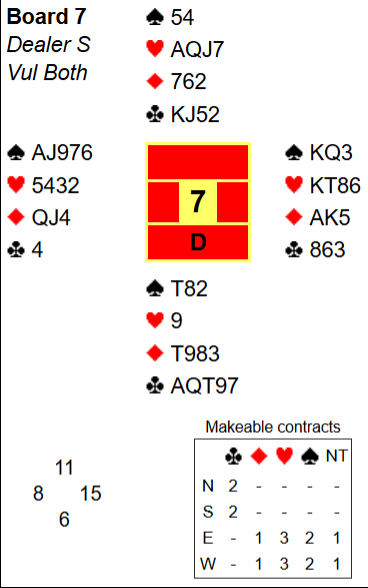
George opened 2S showing 8-11 with exactly 5S. I could (and arguably should) have bid 2NT asking for further clarification. In my defence he had played the last 6 hands! I was tired of being the dummy. I bid 3NT. South chose the passive DT lead. I surveyed the dummy and reflected on the wisdom of bidding something other than 3NT. Anyway, here I was, so I had 8 tricks. Best to do something fast so I won the DQ and led a H from the dummy. North flickered (thought for a moment) then played low. I won the K confidently and claimed my 9 tricks. Notice that we couldn’t make 4H or 4S (or 3NT!) so this was a bit of a triumph.
This was a win that reflected better bridge maybe:
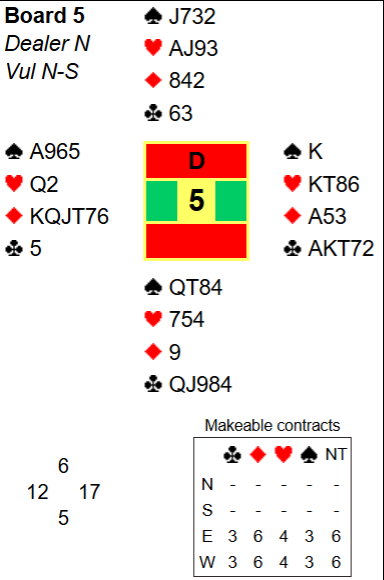
I opened 1C, George bid 1D, I rebid 1H showing 4 hearts and 5+ clubs. He bid 2D, by agreement an artificial bid forcing to game. I bid 3D, rounding out my shape. He bid 4D, a convention that we call optional Minorwood. I responded 5C showing 2 keycards without the DQ but also saying that I was happy to bid a slam (4H would have said that I was not keen on the project!). He bid 6D which had 12 obvious tricks.
The rest of the match was generally in our favour and we won by 37 IMPs. George pointed out to me that we could have won by more if I had made game on board 14. They could obviously have beaten me on a spade lead, however this didn’t happen. I needed to guess the clubs which I could have done in a couple of ways however …
This result got us back in the event but of course … now we got to play David Gue and Josh Tomlin. One of the up-and-coming pairs of Australian bridge. David is the son of one of my favourite partners and teammates Phil Gue. I have played on 2 Australian Open teams with Phil and just won the APBF on a Seniors team with him as a teammate. In my opinion there are few more competitive players than him.
This was the most interesting hand from the match:
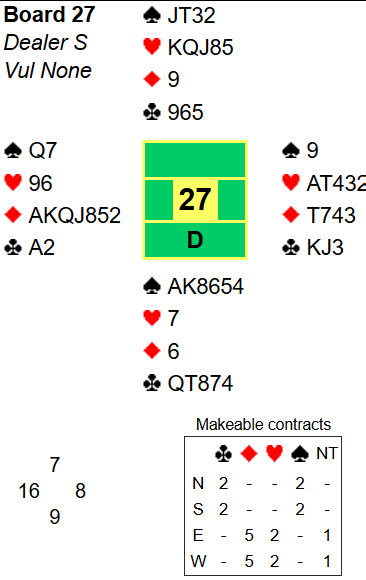
David as dealer tried an adventurous 4S opening. What do you think? I like it.
George overcalled 5D and Josh bid 5S. He didn’t know what was making but this seemed obvious. What should I do as East? Partner was under pressure over 4S so 5D isn’t necessarily that good. I decided to bid 6D. This seemed to have several things going for it. 6D might be making. 5S might be making. Josh might bid 6S in case 6D was making in which case I was going to try double.
As it turned out 6D was passed out and you could say that it was ‘not a bad contract’ since the C finesse would have made 12 tricks however …
What do you think? I think our actions were reasonable but, in the end, 5SX was bad for them and 6D one down was bad for us. They showed good judgement, I think I didn’t.
We won the match by 11 IMPs. They showed good judgement on Board 22 to bid 5D but had a bidding mishap on Board 19 when they missed game( I was a little naughty when David passed 3S after some thought, I said ‘Do you understand that you only get the game bonus if you bid game?’, Josh’s response was ‘What about the slam bonus?’) Nice guys with great attitude, talent and potential.
At the end of day One:
Open (Out of 124 Pairs):
- Margaret Robertson and Quentin Van Abbe 19th with 51.68 VPs
- Hugh Grosvenor and George Kozakos 26th with 48.56 VPs
- Marg Enright and Sue Falkingham 48th with 44.18 VPs
- Jeremy Reid and Seb Wright 113th with 24.29 VPs
Mixed (Out of 28 Pairs):
- Sandra and Andrew Richman 21st with 34.80 VPs
Restricted (Out of 26 Pairs):
- Gek Low and Christine Chodasewicz 26th with 14.04 VPs
I’m not sure how Simon did but I had no adverse feedback!
All the scores are here.